►FMM Sines 2012 – the aftermath

First of all: the few (but invaluable) fellow readers of my blog might have been wondering if this blog has died a premature death. No, not at all, fortunately I can assure you, my friends, that it is not dead. This post can be taken as a factual proof, right?

On a more serious note, I can explain the long absence from posting (two months): in July I had to take care of the last (but most complicated and most stressing) tasks related to my job as a music teacher in public school, like preparing exams, watching some more exams and judging some more exams, again. And add to this the usual meetings. On the other hand, me and my wife had to take care of moving out of our (temporary – that is, for one school year) home. At the beginning of this year, we promised each other we would NOT take more stuff than we needed into this home, but I guess we failed a little. About three cars went full with stuff. In the meantime, the month was coming to an end and finally, we had some (very) deserved holidays, of which we spent two days at Sines.

Sines is a rather smallish town at the portuguese west coast, something like mid-way between Algarve and Lisbon. Normally it is known for its very important international harbour and its petrol raffineries. On another hand it also has a nice beach and pitoresque streets and houses, as well as an old castle to offer. But more important than all this (at least for me):

It is the setting of FMM (“Festival de Músicas de Mundo“: something like World Music Festival).

I’ve already been there two years ago and became instant fan. Absolutely great venue, very nice atmosphere, nice people, no stress or hectic masses of audiences (although it does get really crowded) and fantastic choice of bands and musicians from all around the globe. So, I had to come back this year, and will try to go almost every year, too.

This edition, I managed to attend the following concerts:

Portuguese traditional music meets the classics from Brazil with the very musical and alternative interpretation of two brazilians who came to Portugal:  Luanda Cozetti (vocals) and Norton Daiello (bass) with the help of Ruca Rebordão (percussion) and José Peixoto (guitar) recreate their own versions of all-time classics and also some originals of their own, where they play from soul to jazz-funk.

Bosnian band emerging from the ashes of civil war and becoming one of the most popular projects in eastern europe, mixing folclore with reggae, hiphop and plain, hard and noisy rock. Original and interventional lyrics paired with strong rhythms.

This promising project from Argentina might be one of the best examples for the modern state of Tango, aware of the traditions but inspired by the crowded and uncensored life on the streets of Buenos Aires, taking their tools from Jazz, Rock and even contemporary instrumental composition.

A very talented lady from Mali who grew up with the ancestral blues music from the Wassolou region and although having started as an actress, never stopped believing in herself and made her dream come true: become an internationally known singer.

All members of this ensemble from Republic of Congo have some kind of physical handicap, in fact most of them appear on stage in wheel chairs, making this project a great demonstration of courage and winning the most difficult adversities in life.  Their music, pairing traditional rhythms with Funk and Rumba, won’t leave anybody indifferent.

A portuguese Folk-Rock project with unusual compositions and also a unusual line-up: from a Hurdy-Gurdy (strange instrument, but sounds great… look here if you don’t know what it is: http://en.wikipedia.org/wiki/Hurdy_gurdy) to traditional flutes, bagpipes, concertinas, mandolin and “cavaquinho“.

Definitely the best concert of all, and one of the greatest I’ve ever been at. Absolutely soberb performance, great musicianship and perfect sound. Stunning. I’ve already dedicated one chapter of my series “Alternative Music Lounge” to Dhafer, check it out here for more details. That’s also why I include the video-report of the actual concert he gave at FMM Sines 2012, rather than one of his music videos, those you can find on the article or directly on youtube.

In 2010 (at FMM as well) I heard for the first time one of the very special “throat-singers” of the Norwegian Swami people (Wimme), now it was time to hear Mari Boine, also representing these unique Shaman music traditions.


And that’s it. I wish I could have stayed longer… See you next year, FMM Sines!

►The Alternative Music Lounge: Daniel Mille Quintet

Finally a new episode for this series =)… This one is about french Jazz Accordionist Daniel Mille who I happened to “discover” while listening to a radio program that was transmitting a recording of a live concert at OndaJazz Bar.

I really enjoyed his tunes… dreamy and inspiring, very melodic and showing great musicianship of him and also all other members of the quintet (Alfio Origlio – piano, Jérome Regard – double bass, Julien Alour – flugelhorn, Pascal Rey – drums).

On YouTube I was not able to find videos of the same combo (first two videos is Daniel Mille together with André Ceccarelli, Jérôme Regard, Stéphane Belmondo while the third is with Remy Vignolo, Eric Legnini and Pascal Rey and the last features Alfio Origlio, Jérôme Regard, Julien Alour, Andy Barron) but the music is as good as what I heard on radio, so have a listen by yourself right now:

L’Attente

Les Beaux Jours

Ouro Preto (original by Daniel Goyone)

At Montreal Jazz Fest (video is an excerpt)

To finish this post, here are some more links about him:

http://www.myspace.com/danielmille

http://daniel-mille.artiste.universalmusic.fr/


About this series:

One of the ideas I have for this blog is to start periodic post series about a few interesting topics. Like one post a week or a month, about the same topic but always bringing you new (or classic but little known) musical discoveries.
This series that I gave the name “The Alternative Music Lounge” is about presenting you bands and projects that I like a lot or respect much because of the quality of their music although they haven’t made it into the so called “main stream” and therefore probably will remain unknown for many people.
Whatever might be the reasons for this (sometimes their creations are just too good, too unique, lacking any “commercial characteristics”, othertimes it’s just another case of being disregarded by the music industry, we all know what’s usual to happen…), I think the’re more people out there who might like their music but just didn’t have a chance to discover it yet, so I hope these publications of mine might be helpful.
By the way, if you’re a musician and think I might like your music and would like to propose your creations for being featured in a post of this series, you’re welcome to comment this post or any other future post of this series, stating your project’s name, a link to where I can listen to some tracks and a way to contact you.
I promise to try and listen to everyone’s tracks and respond, even if I happen to not accept the proposal.


►Introducing: “Music from my friends”

Finally had the time to finish production of the first track that’s not composed by myself, so it also is the first track to go on the new page I added to my site some time ago and which had been empty until now.

It’s an instrumental track, more precisely classical chamber music (string quartet and flute), with a dreamy, slightly sad but beautiful melody, composed by Rita Faleiro and produced by me (production environment was ReNoise, using samples and the final mix was done in Audacity).

Go to this page to listen to the track, a free download is also available.

Hope you enjoy 🙂

►War of Tiny Creatures (or: play Worms on Linux)

Last posts were always related to music, so I think (or hope) my readers will “excuse” me for posting “off-topic” this time – although I could even write about astronomy, if I had anything to write about it, because this is my own blog, duhhh… but now I’m really getting off-topic lol…

This post is about an oooooold “addiction” of mine (and many other people as far as I know), more precisely a video game (and believe me, I’m not the video-game-guy AT ALL, I hardly ever play anything…):

Worms Armageddon

Yes, that funny game from 1999 by Team17, about a “nuclear” war between worms.

What?! Don’t know it? Go right now and read more about it, then keep on reading here.

Anyway, this post is not only about this game and me having re-discovered it (again, yes, for the second time, first time was about two years ago, playing against my house mates in my university days), but about something much more special, at least for me:

I am playing it – with almost EVERYTHING working! – on my Linux laptop, yes, you’re reading correctly, here’s a screenshot:

Worms Armageddon on Linux
Worms Armageddon on Linux  (scaled down to fit, click to see full resolution)

I have to say that this is something I always wanted to do (as I don’t have any windows anymore), but until most recently it was very complicated and didn’t work well at all and you had to mess around manually with patches for WINE.

And so I thought I’d share this with you, might come in handy for someone else on the internet out there aswell.

Well, the secret is a program developed by a programmer and “Worms Addict” who calls himself Lookias, that program is a wrapper and also includes – obviously, that’s the heart of all – a patched version of WINE and libraries.

Lookias Frontend to play Worms on Linux

With this program, all you have to do is install W:A (don’t want to know from where you get it or how, that’s not my business) and then you can directly launch it from there, it will run at first attempt (at least did so in my case). You will find instructions in the package itself and also on the other site I list further down on here.

Great work, Lookias!

The only issue I had was sound, first wouldn’t work at all, but then I did a search on the net, and found the solution (which is NOT well documented on the websites I will list further down on here), so I thought I’d better share it aswell.

Sound will start working if you set “Audio Acceleration” in the WINE Settings dialog (under the Tab “Audio”) to “Software Emulation”. Yes, strange at least, but really effective. Will work 90%, which means, sometimes sound will stop working for a minute or so but then start working again, by itself.

With this, the game is 100% playable, and really well. Only thing I didn’t test (never played it before anyway) is Online playing. But as far as I can read from other users’ experience, this should work aswell.

So, here are the links:

Official Website of W:A

Lookias Website (here you get the fantastic frontend)

Website of ViolatoR (quite well written userguide for the frontend)

Have fun!!! 😀

►The Alternative Music Lounge: Jon Gomm

This time, I’d like to present you a musician who until quite recently was almost unknown, the moment that Stephen Fry (an english actor and television presenter) discovered him and decided to share his music to his 4 million twitter followers, saying just one word: “Wow” (read more here). So, by now I might have about 50% of my readers thinking:

« ah, another of those “assisted fame victims”, who raise to world fame and then fall down into the gutter quicker than you can say “G sharp minor seven” and in reality show nothing special »

But the other half of you (hopefully!) waiting with expectation for more details and, obviously, for hearing his music.

Well, if you’re still with me, here we go:

His name is Jon Gomm, he is a guitarist living in Leeds, England and until recently used to do about 200 gigs per year in very small venues or even on the street, just to survive.

Now he is touring Europe and received offers from around the world.

I got to “know” him yesterday, on the portuguese tv talk show “Herman“, where he was guest and played one of his songs.

I was impressed, he manages to combine several special techniques with great virtuosism and musicality, making his guitar sound like three or four instruments at the same time.

This includes complex percussion patterns on the guitar’s body and strings (the drums part), tapping, slurs and harmonics combined with pedal effects and a very neat trick with the tuning pegs, changing forth and back the tuning of the actual note in a way that sounds like a pitch bend (the electric-acoustic guitar part) and adding walking bass lines on the 6th string (the bass part), finishing it all up with his voice, which sounds really nice aswell.

But enough said, have a listen for yourself:

Jon Gomm – Passionflower

Here’s his website: Jon Gomm


About this series:

One of the ideas I have for this blog is to start periodic post series about a few interesting topics. Like one post a week or a month, about the same topic but always bringing you new (or classic but little known) musical discoveries.
This series that I gave the name “The Alternative Music Lounge” is about presenting you bands and projects that I like a lot or respect much because of the quality of their music although they haven’t made it into the so called “main stream” and therefore probably will remain unknown for many people.
Whatever might be the reasons for this (sometimes their creations are just too good, too unique, lacking any “commercial characteristics”, othertimes it’s just another case of being disregarded by the music industry, we all know what’s usual to happen…), I think the’re more people out there who might like their music but just didn’t have a chance to discover it yet, so I hope these publications of mine might be helpful.
By the way, if you’re a musician and think I might like your music and would like to propose your creations for being featured in a post of this series, you’re welcome to comment this post or any other future post of this series, stating your project’s name, a link to where I can listen to some tracks and a way to contact you.
I promise to try and listen to everyone’s tracks and respond, even if I happen to not accept the proposal.

►About practicing a musical instrument

So, lately I’ve been working full-time as a classical guitar teacher, finally I have the job I always wanted.

In this context, I’ve been noticing that up to a certain level of experience, most aspiring guitarists – and not only kids, some of my students are adults – have a serious difficulty in learning the right habits and methods of practice.

I think this isn’t limited to guitarists, I think it happens to many aspiring musicians, I won’t even limit this to classical music.

And it is not necessarily linked to their talent (or lack of) or capacity of discipline and dedication.

So, what exactly am I referring to?

Them practicing for quite a long time, yet not managing to solve certain difficulties or not managing to improve all the exercises or pieces I gave them.

Often the problem is this: they play the exercise or piece over and over, from the beginning to the end, and as if that wasn’t enough, they often try to reach final tempo without having solved technical difficulties at slow tempo first.

So, I thought it could be interesting for some people out there, if I’d write down, right here, what I usually try to explain to them.

How to practice a musical instrument correctly:

• Choose a place where you won’t be bothered and that is silent enough so you can hear yourself very well. It should also have a “positive” acoustic, I mean, it should sound nicely to you, a room with a cold sound or an uncontrolled reverberation can really take the pleasure from playing. Ah, and temperature should be nice, avoid a place that’s too hot or too cold.

• Have a clear idea of what you are going to work (this is something the teacher should help to make clear – point out priorities and what is expected at the next lesson, for example) – if you just “start playing around” it’s hard to accomplish anything.

• Start with something that helps to “warm-up” your fingers – it doesn’t have to be technical exercises, but I really recommend that – a little technique should always be part of your practice. For minimum, stay at this half an hour, or until you feel your fingers are “warm”, but if you want to improve technique or a specific exercise, try to work on this a little longer.

• Then pick up the musical piece your teacher has given priority for next lesson, or, if that’s not the case, pick the piece that you know you’re having most difficulty or have made less progress yet – or that you have less time to prepare for a certain goal.

Now, you have to think first: if the piece is ready for being played as a whole, then you can start with playing it once, from beginning to end, to get “focused”. If it’s not ready yet (if you encounter major difficulties, failures or have to stop repeatedly while playing, then it’s not ready), avoid playing the whole piece.

In this case, begin with the section, part or musical phrase you feel that needs more work, and then continue to the second difficult/less well prepared part/phrase, etc. If it’s a long piece, divide it into several parts. This is where musical analysis is needed – you should have done a basic formal and harmonic analysis to the piece prior starting to play it. Give priority to the parts you know that are less well practised.

While working like that, if you encounter something that you’re simply not able to play most of times because of technical difficulty, many notes simultaneously and not having it by heart yet, speed, sound, dynamics or any other reason, stop and isolate this phrase or section. Try to really locate the problem, “zooming in” to just one measure, a few notes, or even just two notes. When you have found it, practice that little bit of music over and over, until feeling some improvement.

If problem is speed, start slowly.

But do not repeat without making a little break between each repetition – to avoid getting tired, risk of injuries or just to avoid starting to play with auto-pilot – you need to be able to think about what you just played and improve according to that. So you have to listen carefully.

Don’t try to solve it in one session, though, unless you feel you’re almost there, because, remember: you probably have lots of other little bits like this one, probably even lots of other pieces, so don’t loose control and overview of your time. Also, don’t go too far: if you reach the point of fatigue, you won’t be able to improve anymore, so after some time you should move on to another problematic section/phrase.

After a little bit – hopefully having felt some improvement – progress to the next “problem” or to the next section.

And when you feel you dedicated enough time to the piece, go to the next piece, again following clear hierarchy of priority (leave the piece you have most well prepared to the end, because if for some reason you get interrupted or have to finish your practice session earlier than planned – or you might also get “hung up” for more time than planned on some difficulty you really need to solve – then at least you will not leave out any piece that really needs practice).

When you feel that a piece is getting ready for practice at what we call “performance level” (it means you can play the piece at final tempo (or close to) and with all musical, technical and acoustical problems clearly managed), you will have to change strategy for that piece:

• Go through the piece, once, from beginning to end, with the score in front of you, slowing down only on difficult passages – maybe repeating them sometimes, but then move on – or, if you have little time, pick out directly those passages.

• Then, put away the score and play the piece once from beginning to end, by heart, and with maximum concentration, imagining you were playing it at a concert (or really play it to some friend or relative). When you reached the end, look back and analyse carefully how you did. What went well, what went less well, what did you like, what part do you think needs improvement, where did you feel insecure, etc…

• After this critical reflection, get the score and go through the piece again, picking out those passages you stated that need improvement, and work each of them exactly according to what needs to be done (for example: improve memorization, sound, control, dynamics, etc…).

I could add many more tips and details to this post, but I think it would get way too big, so I’ll finish for now, and maybe write a follow-up one day with some more ideas.

Hope that this can be useful for some of you, and now: stop surfing the internet and start practicing, hehehe! 😛

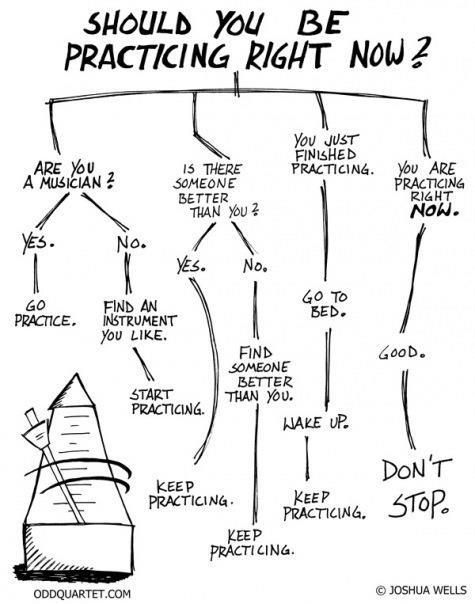
Musical Instrument Practice Humor
A funny pic that says it all, about practicing a musical instrument... (Found on the internet, credit belongs to the original author, it's NOT mine)